Knovium article
From archive search to source-grounded answers
How enterprise RAG turns archives into verifiable answers with citations, pages, and document chains.
Read articleEnterprise RAG for archives and documents
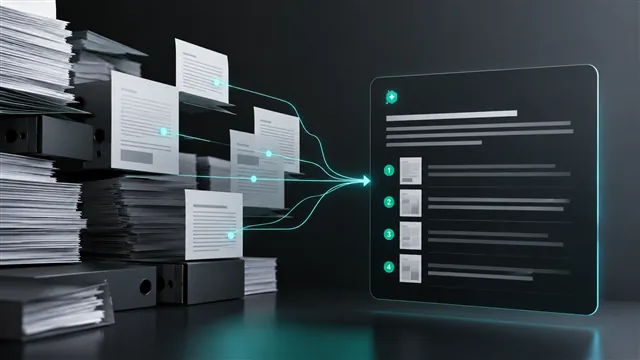
Teams are not looking for files. They need causes, decisions, requirements, and document chains. Knovium combines retrieval, industry ontology, and answer generation so every conclusion can be checked against a document, page, and passage.
The system is deployed as an AI layer over existing repositories: ECM, SharePoint, network folders, PDF archives, scans, and spreadsheet attachments.
Connect sources without archive migration and preserve access rights.
Extract text, tables, metadata, pages, and links between business objects.
Find relevant documents, passages, table rows, and event chains.
Generate answers with verifiable citations, limits, and recommended next actions.
Knovium is designed for complex archives where answer quality depends on relationships between documents, equipment, contracts, and events.
In oil and gas, a single asset moves through dozens of documents: equipment passport, defect reports, work orders, procurement contracts. Knovium links them into a chain so an engineer gets a "why was it replaced" or "what confirms the downtime" answer in seconds instead of digging through the archive by hand. This matters most during incident reviews and regulatory inspections, where every conclusion needs to rest on a specific document and page rather than an engineer's memory. The larger the field and the longer the equipment history, the more time a team typically loses assembling evidence by hand — and the bigger the payoff from a ready-made answer chain.
See the demo for this industry →
In mining, tracking equipment runtime, maintenance regulations, and safety directives scattered across systems is critical. Knovium consolidates them into one answer source and shows which act or regulation backs each conclusion. At an open pit or underground site, downtime on a single machine is costly, so a repair-or-replace decision needs to be justified quickly and tied to a specific regulation, not a verbal agreement. Knovium helps the chief mechanic and safety team pull up a machine's service history in seconds instead of searching across separate registers and folders.
See the demo for this industry →
In energy, an outage or equipment failure requires a fast root-cause review across test protocols, inspection acts, and regulator directives. Knovium gives dispatchers and engineers a verifiable answer with an exact page reference, not a generic summary. After a technical incident the clock is often measured in hours: someone needs to quickly confirm whether the equipment passed scheduled tests and whether earlier deviations were logged. Knovium lets a team pull the full history of an asset — from the commissioning protocol to the latest inspection act — in a single query instead of polling several departments in parallel.
See the demo for this industry →
In metals and metallurgy, decisions on downtime or replacing a unit rely on smelting logs, defect acts, and furnace or mill maintenance regulations. Knovium assembles the answer from these sources and shows the justification chain for a technical audit. These decisions are often reviewed after the fact — during a defect investigation, an audit, or a downtime review — and then it matters how quickly the team can reconstruct what actually happened to the unit over the past weeks or months. Knovium turns scattered shop-floor logs into one answer that both the process engineer and the chief mechanic's team can rely on.
See the demo for this industry →
In construction, disputes over timelines and quality are settled with as-built documentation, hidden-work acts, and contractor correspondence. Knovium finds the right act or contract clause in seconds instead of a manual search through project folders. On a large site, dozens of work types run in parallel, and when a dispute with a contractor or client arises, it matters how fast the team can pull the exact hidden-work act or contract clause that settles it. Knovium spares the project team from manually re-reading correspondence and folders that are organized differently on every site.
See the demo for this industry →
In logistics, disruptions need a fast answer: what confirms the downtime, who owns the SLA, which document supports the claim. Knovium extracts the answer from logs, acts, and spare-parts requests with an exact page reference. When a client or partner disputes a missed deadline, the logistics team usually has little time to pull supporting documents before an SLA penalty kicks in. Knovium quickly assembles the evidence chain — from the incident log to the recovery act — and backs the answer with references to specific pages instead of a recollection.
See the demo for this industry →
In retail, incident review depends on quickly pulling delivery history, supplier contracts, and shortage acts. Knovium gives a single chat over all of these documents instead of searching several systems in parallel. Delivery discrepancies and supplier claims need to be closed quickly, while details are still fresh and claim deadlines haven't passed. Knovium helps a category manager or in-house counsel pull the right contract, invoice, or shortage act with a single question, instead of switching between the ERP system, email, and a folder of scans.
See the demo for this industry →
In healthcare, accountability requires traceability: which protocol was applied, which act closed equipment servicing, which standard was in force at the time of a decision. Knovium returns an answer with an exact document and page reference suitable for internal audit. During a quality review or an internal investigation, it matters to reconstruct exactly which protocol was in force at the time of a decision and whether the equipment was technically sound. Knovium lets a clinic or engineering team quickly pull the protocol, service act, or certificate and show that the decision was justified at the time it was made.
See the demo for this industry →
This is a chat over a synthetic Knovium archive. Pick an industry and a question — the answer is assembled from several documents with page numbers and a source chain.
ROI is treated as a verifiable hypothesis, not a promised outcome. Before deployment, Knovium records the baseline: search time, share of answers supported by sources, and workflows that still require manual review.
4-6 weeks
An archive audit and a working MVP on a slice of real documents — to test the hypothesis before a bigger investment.
$6,000–10,000
8-12 weeks
The MVP is rolled out to a real user group and a broader slice of the archive, under near-production conditions.
Priced after Discovery + MVP
per agreed plan
Rollout across the organization based on the accuracy and coverage metrics validated during the pilot.
Priced after the pilot
We don’t quote the next stage’s price up front — it is set based on what Discovery + MVP finds in your archive, and later on the pilot’s results.
4-6 weeks · up to 5,000 documents · up to 50 users
EUR/GBP/RUB/KZT rates are approximate and shown for reference only; the exact amount and contract currency are fixed in the commercial proposal.
How enterprise RAG turns archives into verifiable answers with citations, pages, and document chains.
Read article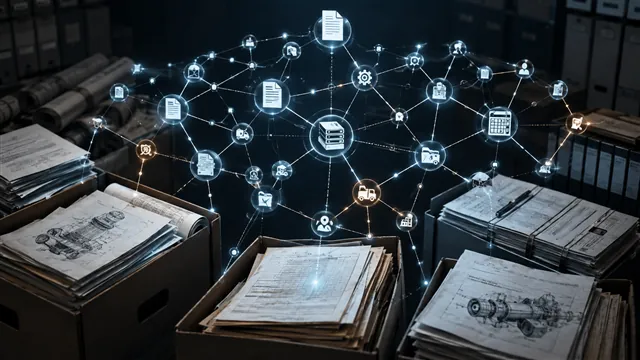
Three documents, three facts, but not one story. GraphRAG links them into a chain so you see not just the text but the asset it is about.
Read article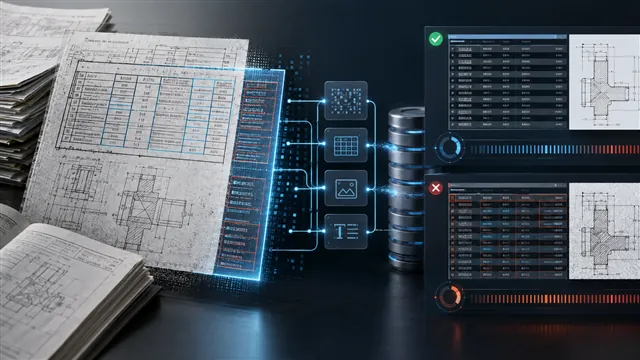
A pilot on ten clean PDFs says nothing about the rest of the archive. Usually most of it is scans and complex tables.
Read article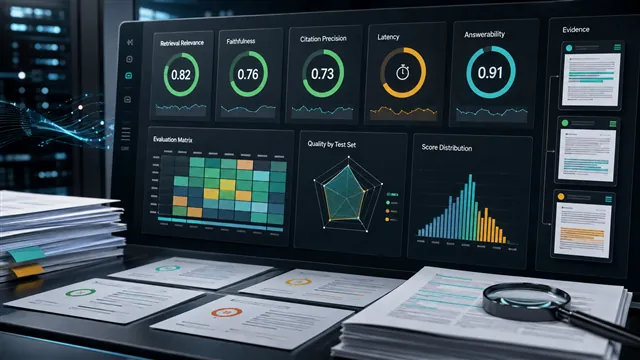
"The pilot went well" is a sentence with no numbers in it. What is needed is a metric matrix, not a general impression from a few good answers.
Read article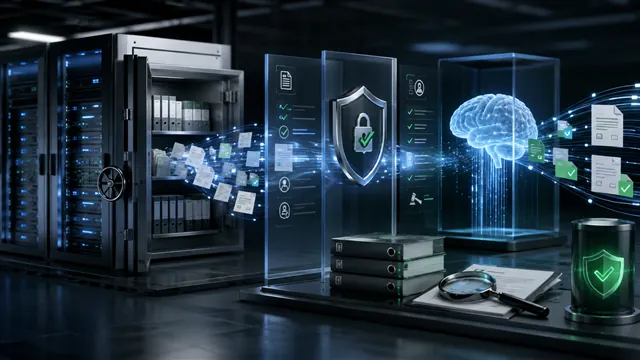
An accurate quote from a contract you have no access to is still a data leak — it just travels through a chat window instead of a file share.
Read articleAn employee asks the AI assistant a question about a contract they have no role-based access to — and gets an accurate, well-cited answer with the full text of the terms. Formally, the system worked perfectly: it found the document and answered with a source. In substance, it's a data leak — it just traveled through a chat window instead of a file share.
Illustrative 0-100 scale showing the share of typical access and data-leakage risks addressed at each control level; used as a reference point when designing the security architecture with a client.
Everything you need to know about Knovium, GraphRAG architecture, security, and enterprise pilots.
Knovium is an enterprise AI layer and knowledge assistant built for complex technical archives, scanned records, spreadsheets, and engineering documents. Unlike basic keyword search or generic chatbots, Knovium delivers verifiable answers directly citing exact documents, pages, and excerpts.
Standard RAG retrieves isolated text chunks and struggles with scanned PDFs, tabular structures, and document versions. Knovium uses hybrid GraphRAG with domain ontology, interconnecting equipment, defect acts, maintenance orders, and contracts into a unified knowledge graph with proven provenance.
Knovium integrates into existing enterprise storage (EDMS, SharePoint, network drives, relational databases) with zero migration required. It supports native and scanned PDFs (via high-accuracy OCR), technical drawings, Excel/CSV spreadsheets, Word files, and image attachments.
Yes. Knovium fully supports 100% On-Premise and Private Cloud deployments in air-gapped environments without external internet connectivity. All vector indices, document graphs, and local LLMs run strictly inside your security perimeter under enterprise access control (RBAC/ABAC).
The initial Discovery + working MVP phase runs for 4–6 weeks at a fixed price of $6,000–$10,000 (up to 5,000 documents and 50 users) to establish baseline search speed, validate 30–50 benchmark questions, and measure verified ROI. The full-scale pilot (8–12 weeks) follows as Phase 2, with custom pricing calculated from Discovery results based on actual archive complexity.
Describe your archive, industry, and target scenario. The form is submitted through Web3Forms and keeps the extended request fields.